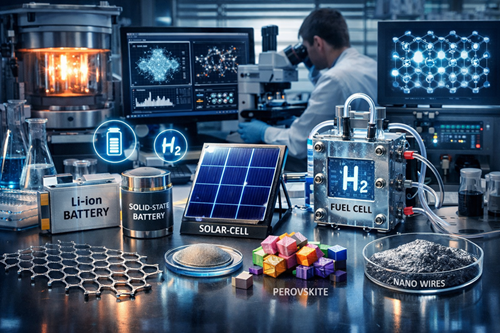
Energy materials research is all about designing, understanding, and improving materials that can generate, store, convert, or save energy more efficiently, cheaply, and sustainably.
The main objectives are to:
Increase energy efficiency
Reduce cost and environmental impact
Improve stability, lifetime, and safety
Enable renewable and clean energy technologies
Key examples:
Solar cells
Silicon (c-Si, a-Si)
Thin films: CdTe, CIGS
Perovskite solar cells
Thermoelectric materials
Bi₂Te₃, PbTe (convert heat → electricity)
Photocatalysts
TiO₂, ZnO for water splitting and hydrogen generation
Fuel cell materials
Proton exchange membranes (Nafion)
Electrocatalysts (Pt, Ni, Co-based)

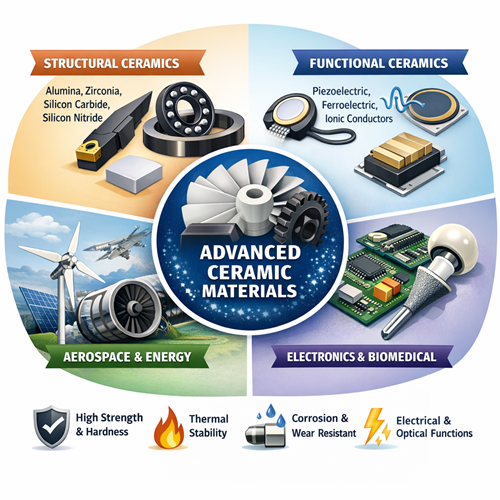
Advanced ceramic materials are high-performance inorganic, non-metallic solids engineered to deliver exceptional properties under extreme conditions. Unlike traditional ceramics, they are designed with precise compositions and microstructures to achieve high strength and hardness, excellent thermal and chemical stability, wear and corrosion resistance, and unique electrical, magnetic, or optical functions.
They are broadly classified into structural ceramics (e.g., alumina, zirconia, silicon carbide, silicon nitride) used in cutting tools, bearings, armor, and high-temperature components, and functional ceramics (e.g., piezoelectric, ferroelectric, dielectric, ionic-conducting ceramics) used in sensors, actuators, capacitors, fuel cells, and electronic devices. Because of their reliability and multifunctionality, advanced ceramics play a critical role in aerospace, energy, electronics, biomedical implants, and renewable technologies.

Self-cleaning smart glass is an advanced functional glass that combines smart optical control with surface engineering to reduce dirt, dust, and maintenance.
It works mainly through photocatalytic and hydrophilic coatings, typically based on TiO₂. Under sunlight (UV), the coating breaks down organic contaminants, while its super-hydrophilic surface allows rainwater to spread evenly and wash away dirt without leaving streaks. When integrated with smart glass technologies (electrochromic, thermochromic, or photochromic), it can also control light transmission, heat gain, and privacy in real time.
Because of these features, self-cleaning smart glass is widely used in buildings, solar panels, automotive windshields, skylights, and display windows, offering energy efficiency, improved visibility, and reduced cleaning cost.